
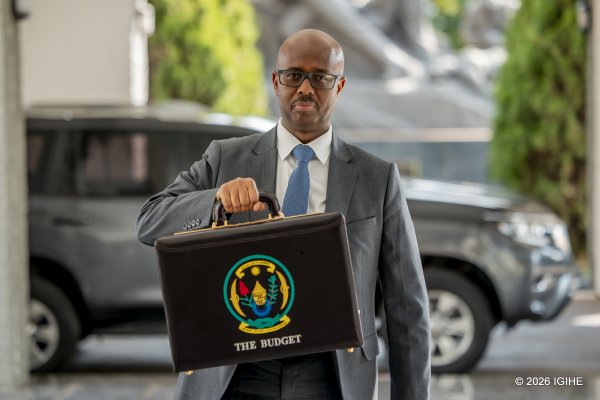
Rwanda unveils a record-breaking RWF 7.8 trillion National Budget for FY 2026/27 amid global economic uncertainty
Rwanda’s national budget for the 2026/27 fiscal year has reached RWF 7.7963 trillion, representing a 12% increase compared to the revised RWF 6.9521 trillion budget for the 2025/26 fiscal year.
For the fiscal year commencing in July 2026, domestic revenue is projected at RWF 5.2738 trillion, including RWF 4.4291 trillion from tax revenues and RWF 582.4 billion from non-tax sources. Meanwhile, foreign grants are expected to amount to RWF 548.3 billion, while external borrowing is projected at RWF 1.9741 trillion.
A total of RWF 4.7885 trillion has been earmarked for recurrent expenditure, including public sector salaries, while RWF 3.0108 trillion will be allocated to development projects and government investments aimed at accelerating economic growth and national transformation.
Speaking on the budget framework, Rwanda’s Minister of Finance and Economic Planning, Yusuf Murangwa, noted that the 2026/27 budget and the medium-term fiscal outlook have taken into consideration the far-reaching implications of the ongoing conflict in the Middle East, as well as the government’s broader revenue mobilization and expenditure management strategies.
The minister emphasized that particular attention has been devoted to strengthening the agricultural sector, notably through enhanced support for fertilizer subsidies, irrigation infrastructure, and continued backing for RwandAir.
Murangwa further explained that the government has prioritized measures to ensure farmers maintain access to affordable fertilizers, thereby mitigating potential food security risks arising from disruptions linked to the conflict involving Iran and broader geopolitical tensions in the region.
“The government has substantially increased financial support to the agricultural sector this year. Last year, fertilizer subsidies amounted to RWF 39 billion. Under the current budget proposal, we have allocated approximately RWF 64 billion,” he stated.
He added that the allocation is approaching a twofold increase, underscoring the government’s determination to prevent fertilizer shortages despite escalating prices on international markets.
“We are fully aware that fertilizer prices have risen globally due to the instability in the Middle East. Consequently, the government has significantly increased funding to ensure farmers continue to access fertilizers and that the agricultural sector remains resilient and productive,” Murangwa concluded.
The expanded budget reflects Rwanda’s strategic effort to safeguard economic stability, strengthen food security, and sustain long-term development ambitions despite mounting global geopolitical and economic headwinds.