RGB shows how residents in 7 Districts of the Western Province perceive livestock services
A recent report assessing the performance of the livestock sector in Rwanda’s Western Province revealed how residents are either satisfied with or critical of the services provided by livestock officers in various districts.
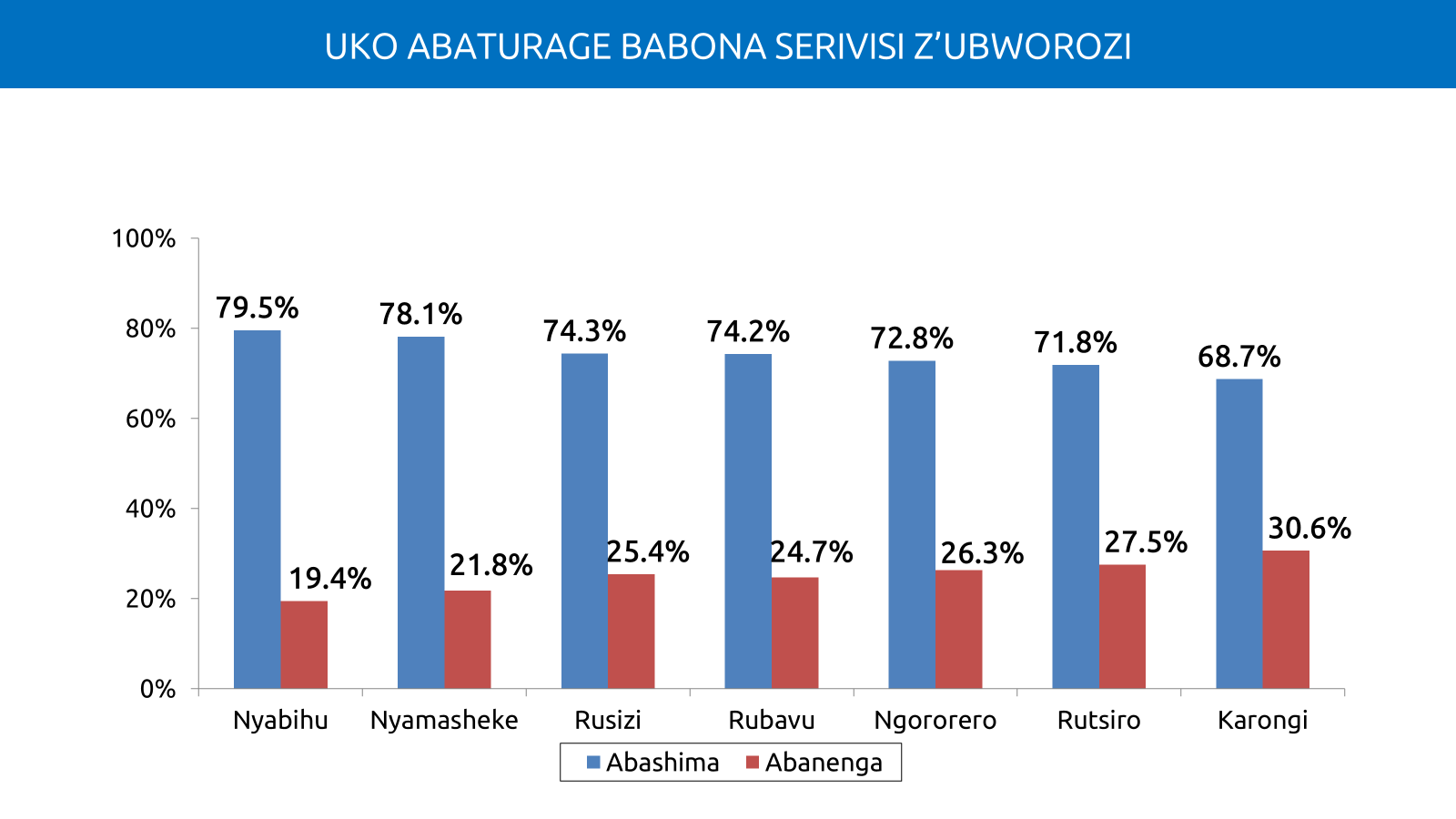
The findings were presented through a graph illustrating the average satisfaction levels—categorized as Abashima (Satisfied) and Abanenga (Dissatisfied)—across seven districts: Nyabihu, Nyamasheke, Rusizi, Rubavu, Ngororero, Rutsiro and Karongi.
Satisfied Residents Outnumber the Dissatisfied Across All Districts, but Declining Trends Are Emerging
The graph clearly shows that in all districts, more than 68% of residents appreciate the livestock services they receive. However, the number of dissatisfied residents is gradually increasing compared to previous years.
Nyabihu ranks highest, with 79.5% of residents expressing satisfaction with the services. This is significantly higher than in other districts, whereas 19.4% of residents indicated that there are still gaps to be addressed.
Nyamasheke also performed well, with 78.1% of residents satisfied with livestock services, although 21.8% believe improvements are still needed.
In Rusizi and Rubavu districts, satisfaction levels stand at 74.3% and 74.2%, while those calling for improvements represent 25.4% in Rusizi and 24.7% in Rubavu.
Ngororero and Rutsiro follow, with 72.8% and 71.8% of residents satisfied. However, these areas show a notable increase in dissatisfaction, reaching 26.3% and 27.5% respectively.
Karongi recorded the most significant drop in satisfaction, where only 68.7% of residents are content with livestock services, while 30.6% believe that the services need improvement.
Interpretation of the Graph
The graph highlights three key insights:
1. A majority of residents are satisfied with livestock services in all districts.
This indicates positive progress in the livestock sector, supported by government initiatives, the work of agriculture and livestock extension officers, and collaboration with development partners.
2. Dissatisfaction increases as you move from the best-performing districts to the lower-performing ones.
This suggests existing gaps in service delivery, including:
Delays in veterinary service delivery
Insufficient livestock medicines
Limited access to livestock water points and pasture
Low farmer awareness on climate change impacts
Inadequate tools, equipment, and infrastructure
3. Karongi and Rutsiro face the most pronounced challenges.
The rise in complaints could be linked to settlement patterns, difficult terrain, or the slow development of supporting infrastructure.