Greenhouse farming boosts Tomato production in Nyabihu District
Members of Tuzamurane-Mukamira Cooperative say they have gained significant benefits from tomato farming, which has enabled them to improve their livelihoods, ensure household food security, and promote environmentally friendly agriculture that conserves soil health.
Their farming is conducted in greenhouses, a system they describe as providing high-quality, organic-like produce that gives them a strong bargaining position in the market, while also helping their children access nutritious food that supports growth and prevents anemia.
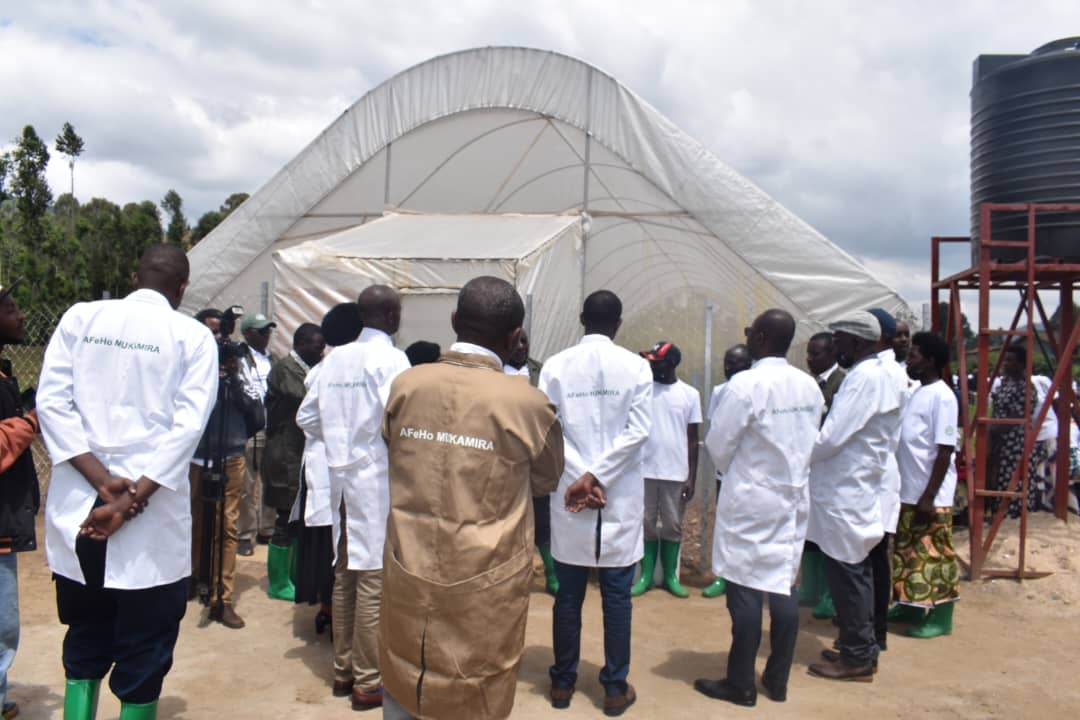
These remarks were made on 25 November 2025 during a field visit by their various partners, including officials from Nyabihu District, agricultural project representatives, and the Organisation Internationale de la Francophonie (OIF), which funds their greenhouse agriculture initiatives.
Today, climate-smart agriculture particularly greenhouse farming, continues to gain traction as a reliable approach to protecting the environment, conserving biodiversity, and building resilience against climate variability.
French Version: https://www.greenafrica.rw/agriculture-en-serre-un-modele-de-resilience-climatique-porte-par-les-femmes-de-la-cooperative-tuzamurane-mukamira/
Marie Rose Bazavuga, the President of Tuzamurane Cooperative, highlighted the economic and ecological benefits of their farming model, emphasizing its contribution to pollinator-friendly ecosystems, especially bees.
“We are grateful for this visit, which strengthens our technical capacity to practice efficient, intensive farming on small plots while achieving significant yields. Our goal is to grow from the ground up so that even if anytime external funding stopped, we would still remain productive because we now have a strong foundation.”She said:
The cooperative members add that they have now mastered modern tomato cultivation and significantly increased production compared to previous years.
“Our partners have helped us boost our tomato yield. We appreciate the climate-resilient technologies they introduced, particularly the construction of greenhouses that protect crops from pests and diseases while maintaining safe conditions for beneficial organisms such as bees, especially those pollinating crops grown outside the greenhouse.”Marie Rose continued:
Martha Nyirabuzuza, the Coordinator of the National Women’s Council in Mukamira Sector, explained that support from The Rwandan Association of Ecologists (ARECO) has enabled women farmers to receive continuous training in improved tomato agronomy, allowing them to grow tomatoes even in cold-prone areas.
“Tomatoes generally do not tolerate cold temperatures, which is typical of Nyabihu District. Growing them in open fields used to be nearly impossible due to pests, frost, and cold-related diseases. However, with greenhouse technology, the tomatoes now grow faster and healthier, we expect to harvest within two months, something impossible outside.”She added:
“This project has empowered us as women. We can now contribute to our households’ income and supply fresh produce to wider markets across the country.”
The farmers further note that the initiative is expected to improve household well-being by combating malnutrition and reducing stunting among children, as tomatoes contain essential micronutrients that help increase blood levels.
Placide Bizimana, the Executive Secretary of Mukamira Sector, commended the cooperative’s effective use of the funding and their transition to climate-resilient agriculture.
“This cooperative had prior experience in farming, but with the intervention of ARECO Rwanda and support from the Francophonie community, they upgraded to a more sustainable and climate-smart production model. Tomato farming was previously unviable in this area, but now the plants are thriving.”He stated:
“The project has also strengthened social cohesion among women farmers, enabling them to share knowledge, improve household welfare, and reduce isolation.”
The cooperative’s development partners have played a crucial role by providing training on soil management, nursery preparation, integrated pest management (IPM), and crop handling until harvest. They have also supported study tours that expose farmers to innovative techniques and promote continuous learning.
Greenhouse farming in Nyabihu is expected to significantly enhance the quality and diversity of crops grown in the district, which traditionally relied on cold-tolerant crops such as potatoes.
Through support from the Organisation Internationale de la Francophonie (OIF), these women farmers are part of a broader effort to expand modern, sustainable agriculture across Rwanda, a sector that employs more than 70% of the population.